
Paid Media
November 6, 2026

Paid Media
16 min read


CSO & Co-Founder at Explore Agency
Bohdan (Bo) leads strategy at Explore Agency, where he and his team develop growth systems for businesses in the home services, healthcare, and legal sectors. Their work centres on helping organizations achieve more predictable and profitable growth.
Book a Discovery CallFacebook ads for contractors reach homeowners who are not yet searching, producing a lower cost per lead than Google. That gap reverses when you measure cost per booked job. Unless campaign objective, offer, and CRM handoff are right, the leads from your paid media campaigns rarely turn into scheduled work. This guide covers setup for roofers, plumbers, and flooring companies in depth.
An HVAC contractor runs a June campaign and watches a strong lead count arrive within days, while the crew is already booked three weeks out. Most leads sit untouched until someone remembers to call. By then, a competitor has the job. The campaign worked. The business was not ready for what it produced.
Google Search captures demand: someone types "emergency plumber near me" and your ad appears. Meta creates it. You interrupt a homeowner scrolling their feed who did not ask for a roofer but had hail come through two nights ago. That difference in intent explains why the economics diverge so sharply between the two channels.
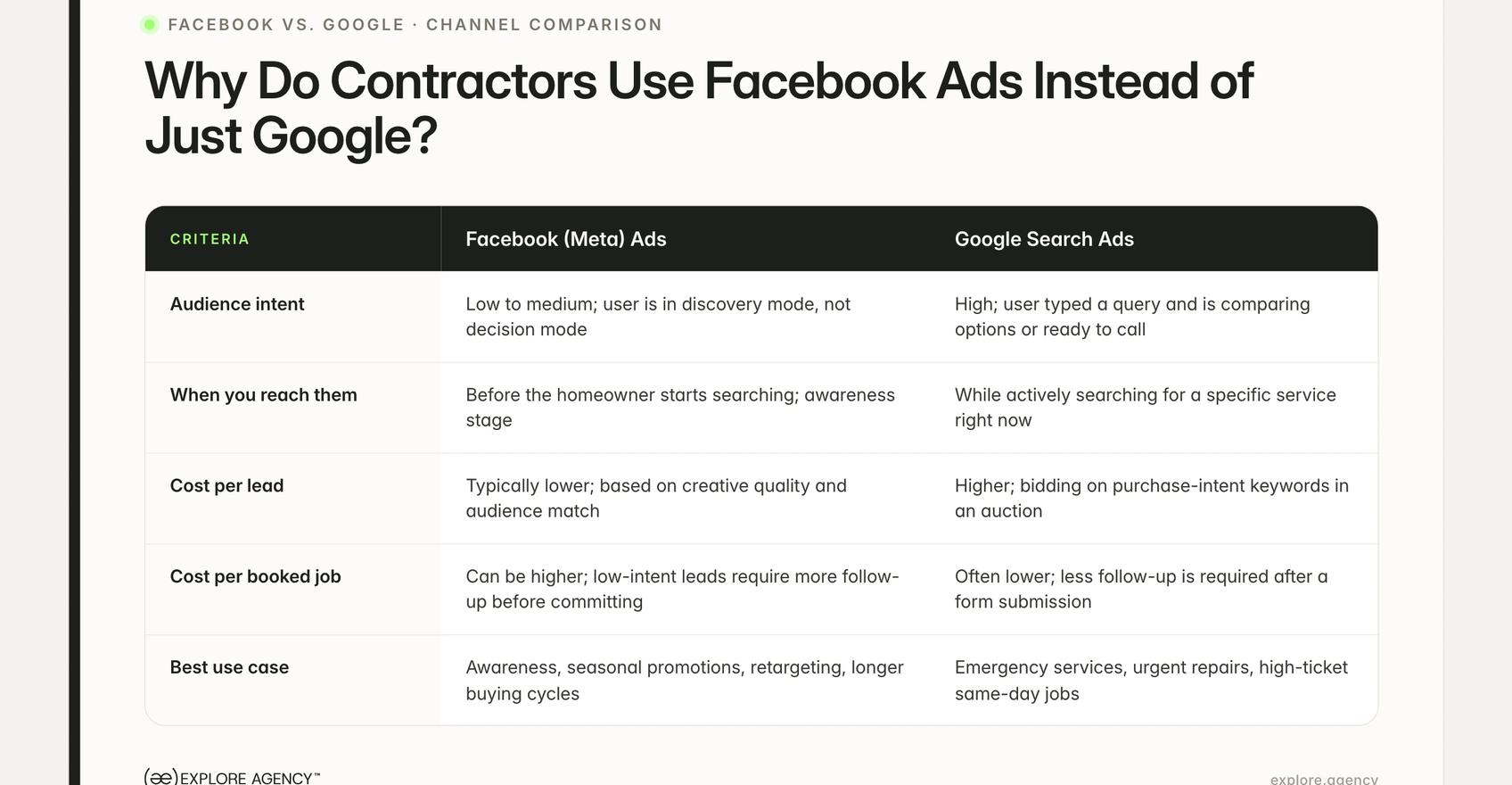
Facebook (Meta) Ads:
Google Search Ads:
A cheaper lead is not a better lead. That tension is the central problem this guide works through.
The direct answer: Use Lead Generation or Conversions. Never Traffic or Engagement for lead capture.
Traffic campaigns optimize for clicks to your website. Engagement campaigns optimize for likes and shares. Neither one tells Meta's algorithm to find people likely to submit a form or book a job. When a contractor runs a Traffic objective with a "get a free estimate" call to action, Meta fills the budget with the cheapest clicks available. Most go nowhere.
Campaign objective decision checklist:
If your business is running facebook ads for contractors and the objective is set to Traffic, that one setting explains most of your low lead count.
The direct answer: Instant lead forms produce more completions at lower cost. Landing pages produce fewer leads with higher buying intent.
Meta's instant form pre-fills the user's name, email, and phone from their Facebook profile. Three taps and they have submitted. That frictionlessness is a problem: the same person who submits in 15 seconds is also the one who does not answer your callback. They were curious, not ready.
A landing page requires the user to leave the app, load a page, and type their information. The extra friction filters out browsers. The homeowner who gets to the bottom of your roofing page and fills out the form has demonstrated enough intent to earn a callback.
When to use each format:
The offer is the difference between a scroll and a click. Generic copy ("Quality work at competitive prices") produces no response. A specific, low-commitment entry point tied to the homeowner's current situation drives form submissions.
The standard entry offer for roofing is a free storm damage inspection. After a weather event, that offer is precisely relevant to a homeowner who does not yet know whether they have damage. Storm geofencing after a hail or wind event increases offer relevance across the right zip codes; for the full timing and radius playbook, see the roofing leads guide. Bryer Roofing is a client example in this vertical where paid media drove inbound at the offer level.
For facebook ads for hvac contractors, a seasonal tune-up offer in spring and early summer aligns the ad with the homeowner's purchase timing. AC season creates urgency organically. The critical operational question is whether your team can handle the volume a successful campaign creates.
A campaign that runs in June when your crews are already at capacity delivers leads your company cannot book. By the time anyone calls those leads back, days have passed and the homeowner has already found someone who answered. Offer timing and crew scheduling need to be coordinated before launch.
The emergency hook and 24/7 framing are the standard play for plumbing. The alignment problem: if your ad says "Emergency plumber available any time" but no one is monitoring the CRM overnight, a lead submitted at 2 AM goes to whoever picked up the Google LSA call first. The ad promise must match your actual answering capacity. How to allocate budget across Meta and Google for plumbing campaigns is covered in the plumber advertising guide. Drain Express is a case study in this vertical.
The free in-home estimate is the natural offer for flooring, because the sale requires a site visit regardless. Before-and-after project content builds aspiration in the feed before the homeowner clicks. Seasonality matters: spring and early fall drive renovation demand. Projects of larger scope attract higher-intent leads, so messaging that references room size ("full main floor," "kitchen and hallway") tends to filter out inquiries that never reach a measure appointment. GreenValley Flooring demonstrates this in paid media.
For facebook ads for general contractors, high-ticket project campaigns for EV charger installs and panel upgrades perform when the audience is filtered tightly. A wide-radius campaign fills the funnel with apartment renters and condo owners who cannot authorize electrical work. Homeownership status, home value, and household income filters reduce lead volume while improving audience match to homeowners who can authorize and afford the work.
For panel upgrade campaigns, targeting households with longer ownership tenure correlates with older electrical systems and genuine replacement intent. TCL Electrical is a live reference for this approach in paid media.
The direct answer: Layer homeownership status, home value, and behavioral signals on top of demographic targeting. Basic interest targeting is not enough.
Most contractors start with age, gender, and radius. That gets you adults within 20 miles. It does not filter for renters, low home values, or households that moved in recently and have already exhausted their renovation budget. Layering those filters is what makes facebook ads for contractors a targeted campaign rather than broad spending against the wrong households.
Targeting options by trade:
The direct answer: Start at the minimum viable spend for your trade, evaluate signals after two weeks, then scale.
Under-spending is a more common failure mode than over-spending. A campaign that never exits Meta's learning phase because the daily budget is too low produces misleading results. Contractors often conclude that facebook ads for contractors "do not work" when the real issue is an insufficient test budget.
Budget allocation breakdown:
Get Started
We help businesses turn strategy into measurable growth through better positioning, websites, paid media, SEO, and AI systems. Let’s look at what’s holding growth back and what to fix first.
The direct answer: Because cost per lead measures Meta's algorithm performance, not your business's performance.
A roofer runs Meta campaigns at a cost per lead far below what Google delivers. It looks like a win. The owner pauses Google Ads and redirects the budget to Facebook. Booked jobs drop.
What happened? The Facebook leads were homeowners checking whether insurance might cover damage. The Google leads were homeowners with active damage and a phone in hand. Same headline lead count. Very different buying intent.
This pattern repeats across every trade running facebook ads for contractors: the channel produces volume at a price that looks attractive until you map leads to booked jobs.
Speed-to-lead is the second variable. A lead submitted at 11 AM and called back at 4 PM is competing against whatever competitor answered the Google LSA call two hours earlier. Research shows that contacting leads within minutes dramatically outperforms callbacks hours later in terms of contact and conversion rate. In a low-intent channel like Meta, that gap is wider because the lead did not seek you out.
CRM handoff checklist:
The direct answer: UTM parameters, pixel conversion events, and CRM source fields must all be connected before this question has an answer.
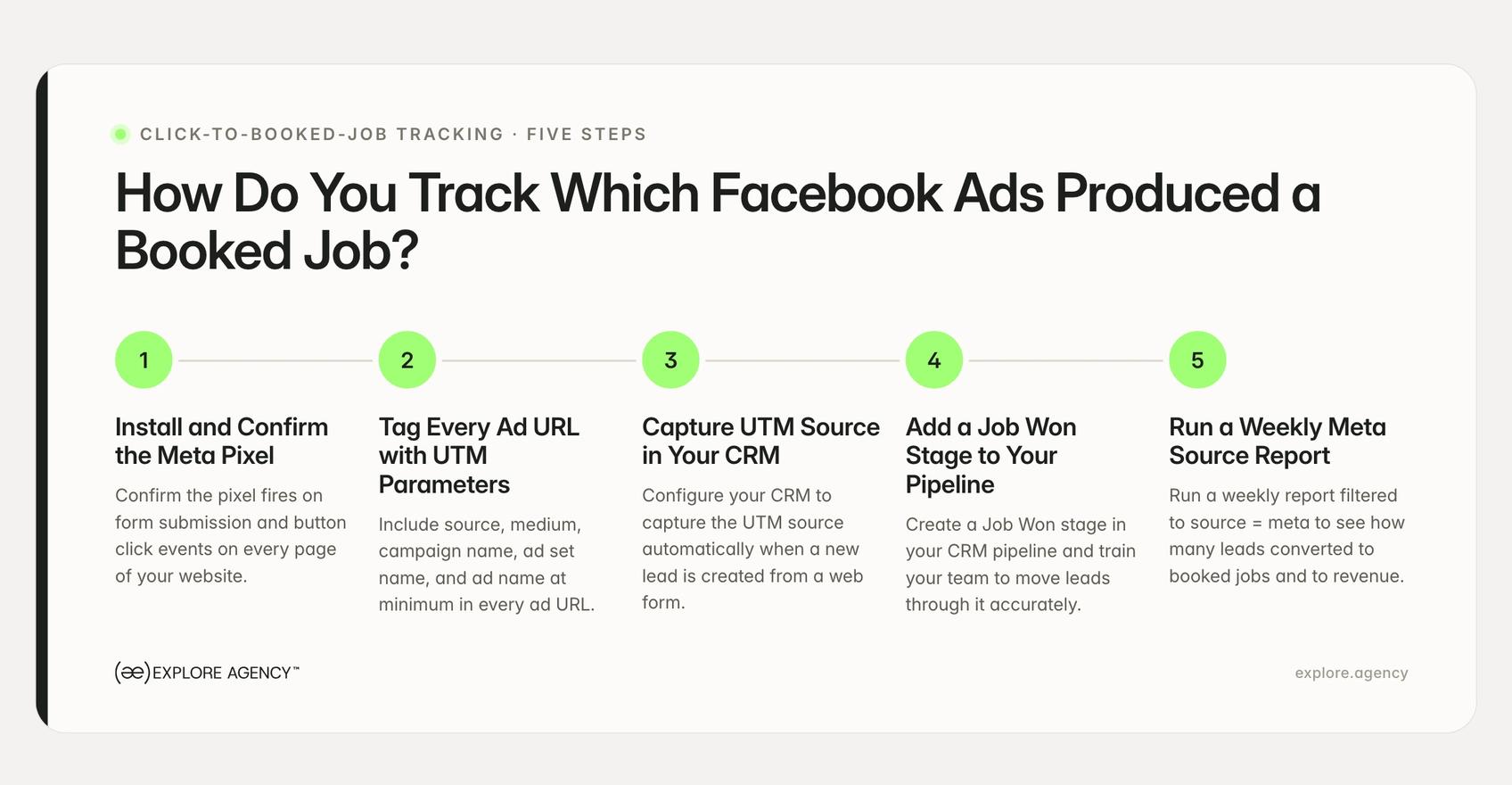
Most contractor marketing dashboards show cost per lead and nothing beyond it. That is not a tracking setup. It is a partial picture that makes scaling impossible, because you cannot increase budget on a campaign you cannot prove produced a booked job. Without that chain, decisions about where to scale facebook ads for contractors versus Google Search are made on a number that flatters the channel.
Tracking setup steps:
Without that chain, you are optimizing for the number that is easiest to measure, not the one that reflects your business outcomes. Measuring from click to booked job, not click to lead, is the operational difference between a campaign you can scale and one you cannot.
The best Facebook ads for contractors share four elements: a hook that stops the scroll, social proof, a specific offer, and a single call to action.
The gap between a weak contractor ad and a strong one is not budget. It is specificity. A stock photo of a house with copy reading "Trusted local contractor, free estimates" tells the homeowner nothing that makes them stop. A real job photo from your city with copy that names a specific problem and a specific offer earns attention because it is relevant to their situation right now.
Creative elements checklist:
Most wasted contractor ad spend originates at campaign setup, before a single dollar is spent on audiences or creative. These are the patterns to fix before launch.
Pre-launch audit checklist:
Start with enough daily budget to generate meaningful signals within two weeks. The right floor depends on trade type, local market competition, and your offer structure. Under-spending in the test phase produces inconclusive data and leads contractors to conclude the channel does not work before the algorithm has had enough conversions to optimize.
Use Lead Generation for most trades when your team can respond to new leads within 15 minutes. Use Conversions when you have a pixel-instrumented landing page running and the offer requires pre-qualifying questions that an instant form cannot accommodate.
The most common cause is a speed-to-lead gap: the lead was low-intent to begin with, and a slow callback gives them time to hire whoever answers first. Instant lead forms attract higher submission volume at lower intent; the offer may also be drawing price-shoppers rather than homeowners ready to schedule.
Lead forms work when your CRM responds automatically within two minutes and your team follows up within 15. A landing page is the better choice when the job type requires pre-qualification before a site visit, or when form quality matters more than form volume.
UTM tagging on every ad URL, pixel conversion events on your website, and CRM source fields must all be in place. Without the full chain, cost per lead is the only visible number, and that number reliably overstates campaign performance.
Explore Agency runs paid media, web and SEO as one integrated system — with revenue tracked to real booked jobs.
Articles
Paid Media
November 6, 2026

Paid Media
November 5, 2026

Paid Media
November 2, 2026

Paid Media
September 26, 2026