
Healthcare
November 12, 2026

Healthcare
16 min read


CSO & Co-Founder at Explore Agency
Bohdan (Bo) leads strategy at Explore Agency, where he and his team develop growth systems for businesses in the home services, healthcare, and legal sectors. Their work centres on helping organizations achieve more predictable and profitable growth.
Book a Discovery CallDermatology marketing covers two fundamentally different patient populations: insurance-dependent medical patients searching for a diagnosis, and cash-pay cosmetic patients researching Botox or laser treatments. Each track demands separate channels, messaging, and budget logic. For practices managing both, specialist clinic marketing requires a split strategy from the start, not a single approach stretched across incompatible patient types.
A dermatologist in a mid-sized market recently noticed something: the Google Ads dashboard showed a strong lead count, the SEO report showed organic traffic climbing week over week, and the front desk stayed busy. A fraction of those leads converted to new patients. The owner blamed the marketing. The marketing had worked fine.
A dental practice markets one patient type. A physical therapy clinic markets one, too. Dermatology markets two, and the channels, margins, and conversion paths are almost incompatible.
Medical dermatology runs on insurance reimbursements, referral networks, and proximity searches. Cosmetic dermatology runs on cash, trust, and the treatment content your competitor posts on Instagram. Standard healthcare marketing advice treats these as the same problem. They are not.
The structural conflict surfaces immediately in budget decisions. Running Google Search Ads for "skin cancer check" and "Botox near me" from the same campaign budget mixes a low-margin, insurer-gated visit with a high-margin, cash-pay treatment. The bid logic, the landing pages, and the follow-up sequences need to be entirely separate.
Cosmetic dermatology marketing also carries a longer consideration cycle. A new patient curious about laser resurfacing may research for weeks before booking, while a patient with a rash books the same day they search. Treating both as a single funnel means your follow-up sequences, ad creative, and content are perpetually out of step with what each patient type actually needs.

The number most practice owners watch is leads. Leads are the wrong number to watch.
A form fill is a name and an email. A phone call is not a booked appointment. A booked appointment is not a kept appointment. At each step, patients fall off, and your ad platform already charged you for every one of them. The real metric is cost per new patient who actually sat in your chair, not cost per click.
Dermatology practice marketing has two separate cost structures because the patient types differ so significantly. Medical patients have a shorter conversion path: they search, they book, they come in because insurance covers the visit. Cosmetic patients carry more friction: they compare providers, read reviews, check before-and-after content, and may submit a form weeks before they ever book. That longer cycle makes cost-per-booked-visit for cosmetic procedures structurally higher.
Understanding this split is the starting point for dermatology marketing strategies that connect to practice economics, not just marketing platform metrics. Generic dermatology marketing ideas, applied without that split in mind, push budget toward channels that do not match how each patient type actually makes decisions.
No competitor on this SERP breaks this down by channel. Here is the split, organized by channel.
Google Search Ads
Google Business Profile and the Local Map Pack
Instagram and TikTok
Referral Networks (PCPs, GPs, Urgent Care)
Email and SMS Recall Sequences
A website that ranks but fails to convert the traffic it earns is a marketing problem. Most dermatology website marketing advice stops at "build a professional site" rather than addressing the conversion mechanics that determine whether a visitor books or leaves.
The fix is structural. Medical dermatology service pages need insurance information visible, provider credentials prominent, and booking tied directly to your scheduling system. Cosmetic service pages need treatment outcomes described, trust signals clear, and a booking flow that reduces friction before the patient changes their mind and calls a competitor.
Above-the-fold layout matters more than most advice admits. A visitor who clicked a Google Ad for "Botox Chicago" and lands on a generic homepage will not hunt for the right service. They will leave. The landing page needs to match the ad's intent, carry a single clear primary action, and load fast enough that the mobile user does not bounce.
Real-time online booking is now a conversion factor, not a convenience feature. A cosmetic patient researching treatments at 9 PM will not wait until Monday morning to call and schedule. If your site requires a callback, you are losing appointments to practices whose sites allow immediate booking.
Local search is where dermatology marketing wins or loses for most owner-operators. The map pack dominates the first screen for high-intent queries like "dermatologist near me" or "cosmetic dermatologist Denver," and the three positions it shows drive the majority of clicks on those searches.
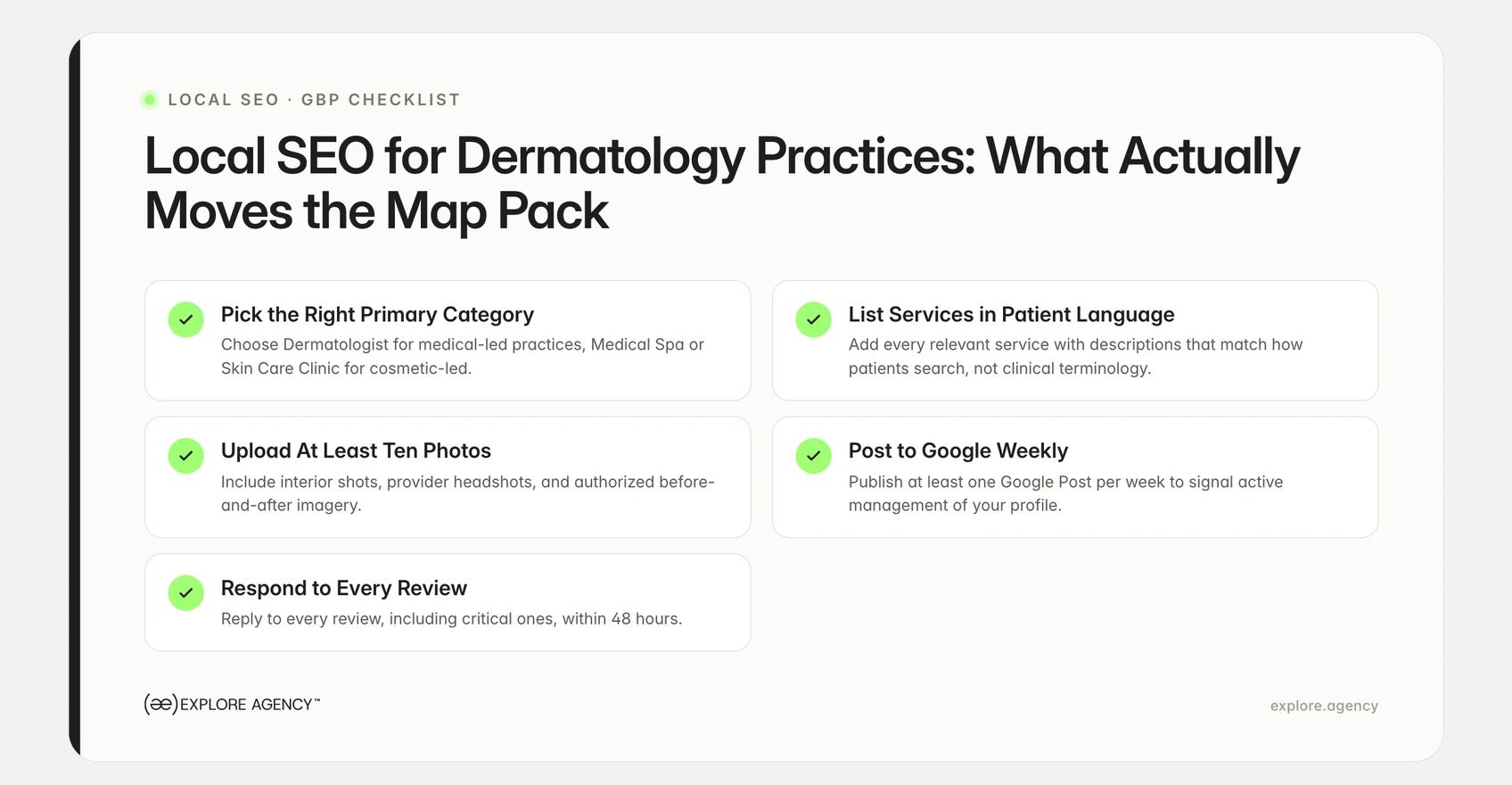
Google Business Profile optimization checklist:
Review velocity is the factor most practices underinvest in. A profile with steady new reviews each month will typically outrank a profile with a larger but stale review count. Recency matters: a practice that collected most of its reviews two years ago and stopped is at a disadvantage against a competitor collecting reviews actively today.
Proximity is real and cannot be optimized away. A practice in Pasadena will not rank in the Los Angeles downtown map pack for someone searching from downtown, regardless of profile completeness. Local SEO supports visibility within your addressable area; it does not extend that area.
Campaign structure is where most dermatology marketing falls apart before the first dollar is spent. Dermatology digital marketing services live and die on how campaigns are organized, and the most common waste pattern is running medical and cosmetic services in the same campaign with a shared budget. When a "Botox near me" click competes for budget with an "acne treatment" click in the same campaign, the system optimizes for clicks. It does not know that one visit is worth significantly more to your practice than the other.
Campaign structure for a dual-track practice:
Google restricts before-and-after imagery in display ads under its Healthcare and Medicines policy. This applies directly to cosmetic dermatology ads: a display ad showing a dramatic before-and-after will be disapproved. Search ads are not affected by this restriction, which is one more reason to weight cosmetic spend toward search rather than display for a new account.
If you are running campaigns across multiple locations, each location needs its own campaign set rather than location extensions layered onto a single campaign. Extensions help the algorithm, but they do not substitute for dedicated location targeting when your practice competes in distinct local markets.

Yes, but with significant platform-level and legal constraints that most practices are not fully aware of.
What the FTC requires (per the FTC Endorsement Guides): any before-and-after photo used in advertising must include a clear disclosure if the results shown are not typical. The disclosure must be conspicuous. It cannot be buried in fine print or rendered in light gray text at the bottom of the image.
What HIPAA requires: any identifiable patient photo used in marketing material requires a written authorization that specifically covers the marketing use. A general treatment consent form does not satisfy this requirement. The authorization must name the specific use and the channel, and patients retain the right to revoke it.
Platform restrictions by channel:
The practical conclusion for dermatology marketing services that include creative strategy: before-and-after photography is a strong organic asset on your website and social channels, subject to HIPAA authorization and FTC disclosures. It faces policy friction in paid placements. Build your authorized photo library for organic use; adjust creative strategy in paid channels accordingly.
Here is the gap no dermatology digital marketing company or agency covers in their published content: the ad platform charges you for every click the moment someone submits a form or calls your practice number. What happens after that click is a front-desk problem. It looks like a marketing problem when you count new patients at month end.
A lead submits a contact form at 9 PM. The front desk sees it at 10 AM the next day. The patient has already called two other practices and booked with one of them. Your CRM shows a lead. Your appointment book shows nothing. Your ad account reports a completed conversion.
The window between form submission and callback is a conversion variable with direct impact on your dermatology marketing results. Research on lead response behavior consistently shows that contact rates drop significantly within the first hour and fall sharply after the first day. This is not unique to healthcare, but it is especially costly in cosmetic dermatology where the patient has no clinical urgency and will simply book with whoever reaches them first.
What closes this gap:
Get Started
We help businesses turn strategy into measurable growth through better positioning, websites, paid media, SEO, and AI systems. Let’s look at what’s holding growth back and what to fix first.
Reviews affect your map pack position and your conversion rate simultaneously. A strong review profile moves you up in local rankings and persuades the patient comparing two practices on the results page to click yours. Neither benefit arrives without active management.
Timing the review request matters. A request sent while the patient is checking out captures peak satisfaction but puts some patients in an awkward position if the visit did not go perfectly. A request sent 24 hours post-visit, when the patient is home and reflecting on the experience, typically produces both higher response rates and more thoughtful content.
Platform allocation by patient track:
Responding to critical reviews is not damage control alone. A measured, non-defensive response to a one-star review often persuades the reader, not the original reviewer. Treat the response as a demonstration of your practice culture.
Social media content for medical dermatology has limited conversion value. The audience discovering your eczema-treatment content on Instagram was not planning to book that day. For medical services, social is a brand awareness layer at best.
Cosmetic dermatology marketing on social functions differently. Cash-pay patients are more heavily influenced by provider trust signals, treatment content, and before-and-after results than by clinical credentials alone. Instagram and TikTok content that shows the experience, the results, and the provider's personality builds a consideration audience that converts through search when the patient is ready to book.
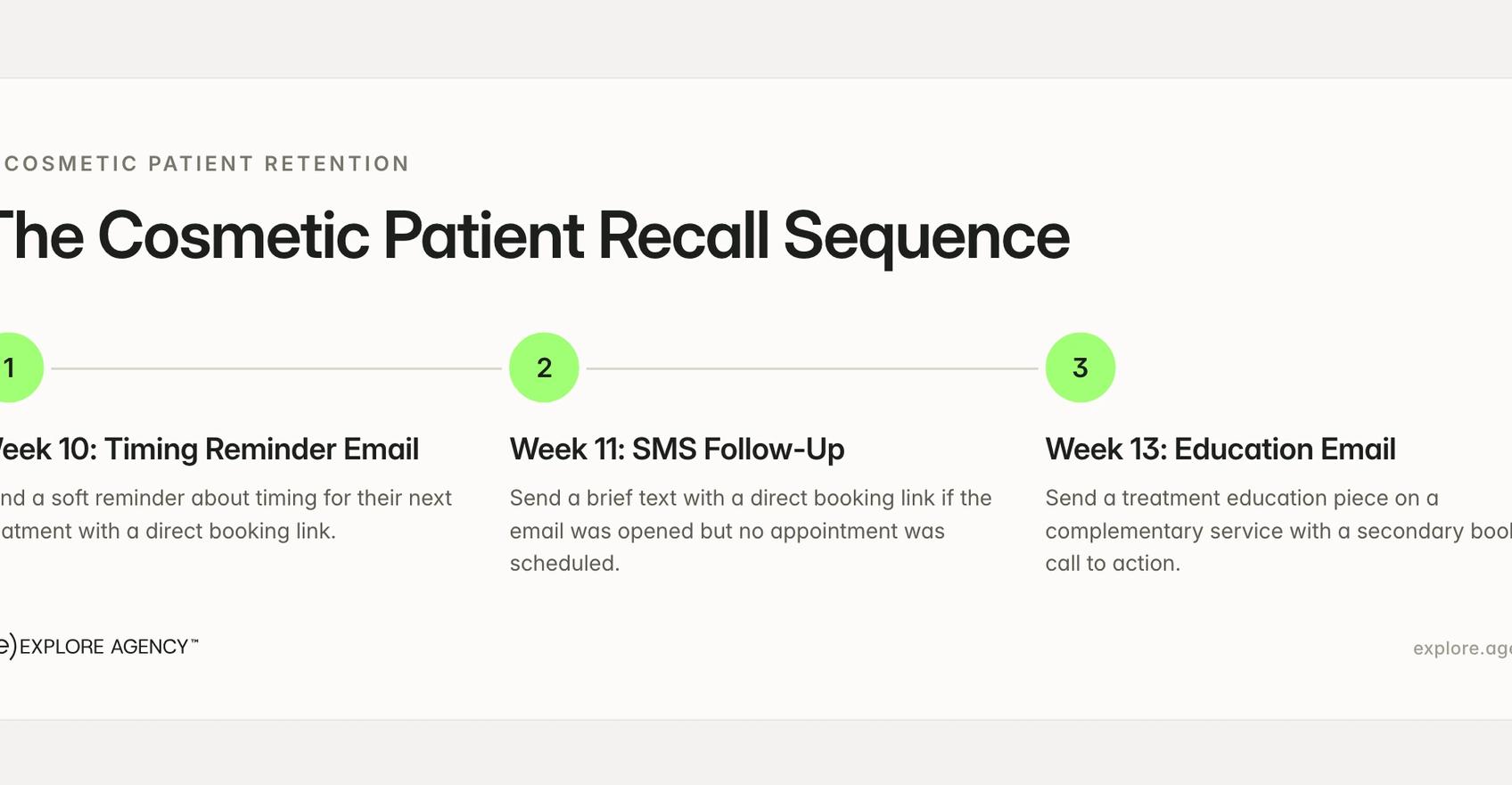
The more important retention tool for cosmetic patients is email and SMS recall. A cosmetic patient books every three to four months on average. The window between visits is when competitors are running their own ads and posting their own content. An automated recall sequence triggered around week 10 after a visit puts your practice in front of the patient at the right moment, without spending another dollar on acquisition.
A basic cosmetic recall sequence:
This sequence works because the cosmetic patient already trusts your practice. You are not acquiring a new patient; you are recovering one who would otherwise book with whoever reached them first.
Your Google Ads campaign reports impressions, clicks, and conversions. Your SEO report shows organic sessions and keyword rankings. Neither tells you how many new patients those numbers produced or what they cost.
The measurement gap is the most common reason dermatology marketing spend feels disconnected from practice growth. Traffic climbs, but the schedule does not look any different. The disconnect lives between the marketing platform's conversion event (a click, a form fill, a call) and your practice management system's new-patient record.
Closing that gap requires three things. Call tracking numbers assigned to each marketing channel let you distinguish a patient who called from Google Ads versus organic search versus a referral. UTM parameters on every booking form URL carry channel attribution into your CRM. A process for matching marketing-attributed contacts to actually kept appointments completes the loop, because no-show rates vary by channel and by patient track. Knowing which channel produces patients who keep appointments, not just patients who book, is the number that actually correlates with practice revenue.
The FCP Dermatology case study at explore.agency shows how integrated tracking connects ad spend to new-patient flow for a practice running both cosmetic and medical services. When paid media, website, and CRM data share a single system, the question changes from "is marketing working?" to "which part is working, and which part do we scale?"
What separates the best dermatology marketing agencies from generic healthcare vendors is integration of tracking across channels, not the number of services offered. A full-service dermatology marketing company or dedicated digital marketing agency runs paid, website, and SEO as one system with shared attribution rather than three separate invoices pointing fingers when the schedule looks flat. The integration is structural; it cannot be bolted on after the fact.
Dermatology marketing costs vary significantly based on whether you run cosmetic services, medical services, or both, and which channels you prioritize. Cosmetic digital advertising through Google Ads and paid social typically requires larger budgets than medical practice development, which leans more heavily on local SEO and referral-network building. The best dermatology marketing services integrate paid, website, and attribution into one trackable system rather than offering each channel as a separate line item with no shared measurement.
For medical dermatology, optimizing your Google Business Profile and building referral relationships with primary care providers are the highest-ROI starting points for new-patient flow. For cosmetic dermatology, Google Search Ads targeting high-intent treatment queries in your city and an active social presence with authorized before-and-after content drive the most attributable new patients. The best dermatology marketing strategies combine both tracks with separate channels, messaging, and attribution rather than treating them as one audience.
Claiming and fully completing your Google Business Profile is the fastest path to map pack visibility, with accurate categories, complete service listings, photos, and an active review collection process in place. For organic rankings, your website needs separate pages for each major service with content written around the specific questions patients search before booking. Local SEO for dermatology practices compounds over time; practices that rank consistently treat profile management and review velocity as ongoing operations, not one-time setup tasks.
Yes. Cosmetic and medical dermatology require separate landing pages, separate ad campaigns, separate follow-up sequences, and separate budget conversations. Combining them in a single campaign structure causes the platform to optimize toward the wrong signals and produces conversion data too blended to act on. Treating both patient types as one audience wastes spend on the wrong channels for each track.
Google Search Ads can produce leads within days of a campaign going live, though the first several weeks are a learning period where the platform optimizes toward higher-quality conversions. Local SEO shows meaningful movement in map pack positions over three to six months as review velocity builds and profile authority grows, though Google does not publish a fixed timeline for any practice. Attribution-based measurement shortens the feedback loop considerably: when you can see which new patients came from which channel, you stop waiting for signals and start acting on them.
Explore Agency runs paid media, web and SEO as one integrated system — with revenue tracked to real booked jobs.
Articles
Healthcare
November 12, 2026

Healthcare
October 19, 2026

Healthcare
October 19, 2026

Healthcare
October 17, 2026