
Healthcare
October 19, 2026

Healthcare
12 min read


CSO & Co-Founder at Explore Agency
Bohdan (Bo) leads strategy at Explore Agency, where he and his team develop growth systems for businesses in the home services, healthcare, and legal sectors. Their work centres on helping organizations achieve more predictable and profitable growth.
Book a Discovery CallMental health marketing is the system a private practice uses to attract new patients, convert inquiries into booked appointments, and measure which channels drove each result. It spans local SEO, paid advertising, referral networks, and intake workflows. For practices ready to treat it as one connected system, mental health practice marketing is measured at cost per booked patient, not clicks.
Here is a scenario that plays out every night. A patient searches "anxiety therapist accepting new patients" at 11 PM, your practice appears in the results, and the contact form sends no auto-reply. By 8 AM that patient has booked elsewhere. The revenue was there, then gone, and your dashboard shows a lead count with no corresponding appointment.
The compliance layer is heavier than in almost any other healthcare vertical. The 2023 HHS bulletin on tracking technologies established that standard pixels on health-related web pages can capture individually identifiable health information, which means common ad tech setups that work in dental or aesthetics practices create legal exposure in a therapy context. That matters from day one.
There is also a copy problem most general healthcare marketers miss. Direct-response ad copy that converts in a cosmetic clinic does not convert for a practice treating trauma, grief, or addiction. Mental health marketing campaigns require a different tone, different headlines, and different calls to action.
Marketing mental health services at the same message intensity as an aesthetics clinic erodes the trust a patient needs before they will book. A mental health digital marketing agency running the same playbook it uses for orthopedics will produce low conversion rates before it produces new patients.

Local search and paid advertising bring the highest volume of new patients to most private practices, with PCP referrals and directory listings filling the second layer. Build in this order: local SEO first, then paid, then a referral tracking layer. Running all three without attribution means growing without knowing which investment to scale.
Channels ranked by new-patient contribution:
When a patient searches "therapist accepting new patients" in your city at 11 PM, Google determines which three practices appear in the map pack based on relevance, proximity, and prominence signals. Your Google Business Profile controls more of those signals than your website does in that moment. Categories, service areas, booking links, photo recency, and review response patterns all affect where you rank.
A GBP listing only a phone number and a category is not competing with one that has services listed, photos, and an appointment link connected to a live booking page. The gap shows in after-hours inquiry volume. Practices that fully optimize this channel and connect it to a real booking flow convert the same search traffic that was previously bouncing.
Before a mental health practice spends on paid advertising, three compliance requirements apply. Meta's Special Ad Categories include health-related targeting, which restricts the audience parameters available to you. Standard retargeting audiences built from website visitors may expose diagnostic intent data that qualifies as protected health information under HIPAA.
A mental health digital marketing agency that configures campaigns the same way it would for a gym creates compliance liability before the first impression runs. HIPAA-compliant setups use general audience signals, exclude diagnostic-intent page visitors from retargeting, and rely on first-party CRM data for lookalike audiences. The setup takes more time, but it is the only setup that is legally durable.
Referral channels feel reliable until one breaks. Consider a practice whose highest-volume referral source, a local PCP, retires without warning. Without a second referral channel tracked and actively maintained, next month's new-patient count becomes a guess rather than a managed outcome.
The fix is not to build more relationships. It is to track the ones you already have. A UTM structure for referral landing pages, combined with intake form fields that capture how a patient heard about the practice, turns referral volume from an assumption into a data point. That data tells you which provider relationships are worth investing in and which ones look strong on paper but rarely convert.
Yes, and the differences are substantial enough to treat them as separate campaigns. Marketing a mental health practice that accepts both insurance and cash-pay patients requires different channels, different landing pages, and different close-rate expectations. This distinction is absent from most mental health marketing guides and is exactly where practices lose budget on campaigns that reach the wrong patient type.
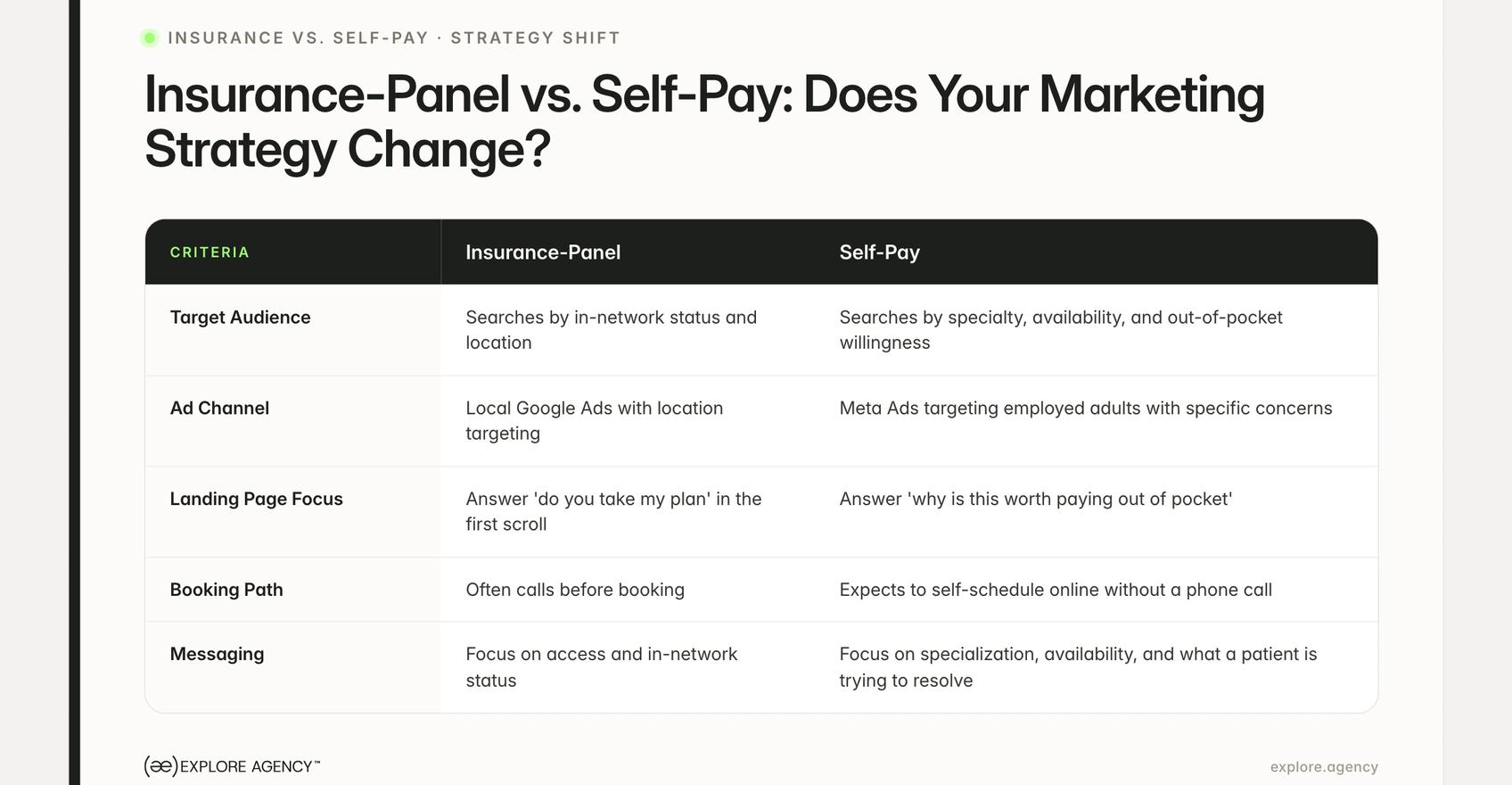
How the two strategies differ:
A practice shifting capacity to self-pay telehealth is not adjusting a campaign. It is running a different campaign entirely.
Audit your pixel placements before spending anything on ads. The 2023 HHS guidance established that tracking pixels on health-related pages can capture data that constitutes individually identifiable health information. Standard Google Analytics and Meta pixel configurations on booking confirmation pages, intake forms, and condition-specific service pages may already be out of compliance before any campaign runs.
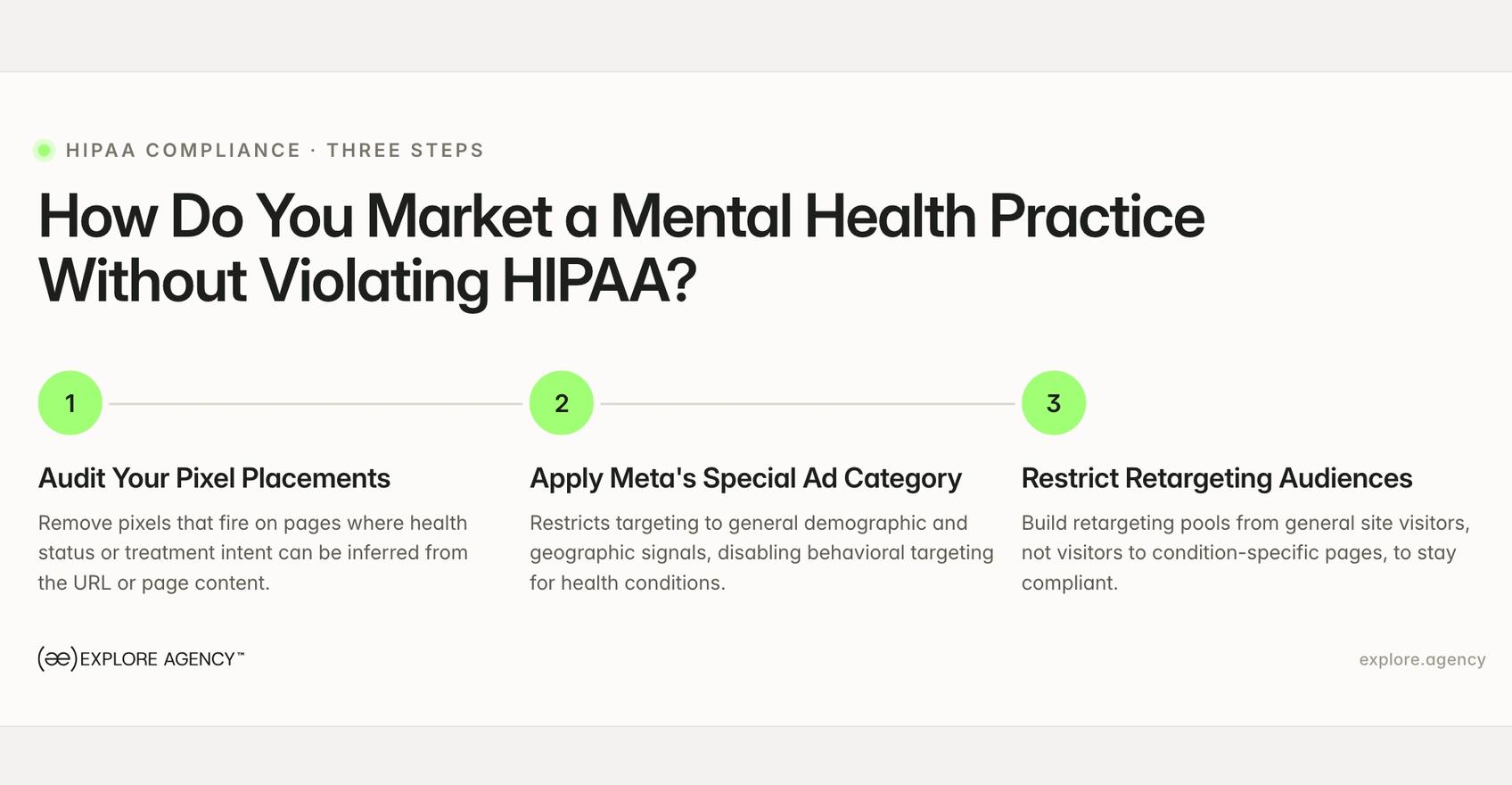
The three steps that protect a practice before any ad dollar is spent:
LegitScript certification adds a specific requirement for addiction treatment advertising. Without it, Google and Meta will not approve campaigns in that category regardless of other compliance steps.

The most expensive failure in mental health practice marketing is invisible. A high-cost click reaches a real patient, the patient fills out a contact form, and no one replies fast enough to book. The dashboard shows a lead. The revenue column shows nothing.
The intake drop-off pattern:
Fixing intake before scaling ad spend is not a minor optimization. It is the prerequisite.
Get Started
We help businesses turn strategy into measurable growth through better positioning, websites, paid media, SEO, and AI systems. Let’s look at what’s holding growth back and what to fix first.
You connect marketing data to intake data, specifically through call tracking, CRM or EHR integration at the inquiry stage, and consistent tagging of how each new patient found the practice. Without those three pieces, every budget decision is made on incomplete information.
KPIs that actually show whether marketing for mental health is working:
Six signs your marketing spend is not connected to actual appointments:
A solo practice and a group practice with multiple associates are running different marketing problems. The solo practice needs visibility and intake efficiency. The group practice needs to fill several clinician schedules simultaneously and runs into limits that standard mental health marketing services built for solo practitioners cannot address.
The growth triggers are specific to stage. Opening a second location requires a separate local SEO presence and a dedicated Google Business Profile for each address, plus location-specific landing pages that compete independently in each city's map pack. A single consolidated website page does not rank for both locations.
Adding an associate clinician creates a demand-generation problem distinct from the practice's existing intake flow. The new clinician cannot rely on the waitlist the senior clinician built. Marketing your mental health practice through a growth phase means running intake for two distinct patient profiles at the same time, often with different payer mixes.
A three-week waitlist is not a reason to pause. It is a reason to seed intake volume for a new associate's schedule, test a cash-pay telehealth line before the waitlist clears, or build pipeline for a second specialty. Digital marketing for mental health professionals in a growth-stage practice requires a different setup than a solo clinician building from scratch.
Most practices that struggle with marketing are not struggling because they picked the wrong channels. They struggle because those channels are managed by separate vendors who share no data. The paid media vendor reports clicks and leads. The SEO vendor reports rankings and traffic. No one reports cost per booked patient because no one owns the full picture.
A full-funnel system connects each layer:
When those four layers run as one integrated team, the question changes from "which vendor is responsible" to "which channel deserves more budget this month." That is the question mental health digital marketing services should be built to answer. Explore Agency's private practice marketing team builds this kind of connected system for specialty clinics and mental health practices across North America.
Mental health marketing covers all the channels and systems a private practice uses to attract, convert, and retain patients, from local SEO and Google Ads to referral programs and intake workflows. The measure of whether it is working is not traffic or exposure, but cost per booked patient and booking rate. A practice that cannot calculate cost per booked patient cannot make confident decisions about where to spend.
The highest-leverage steps are optimizing your Google Business Profile so you appear when patients search locally, running HIPAA-compliant paid ads, and tightening intake response time so leads who find your practice actually book. Most practices lose more patients to slow follow-up than to lack of visibility. Fixing intake before increasing ad spend produces better results from the same budget.
Look for a mental health marketing agency that reports cost per booked appointment rather than clicks and leads, understands HIPAA constraints on pixel tracking and ad copy, and operates your paid, SEO, and website channels as one connected system with shared attribution. A real cost-per-booked-patient number is the sign that the attribution is genuine. Generic monthly PDF reports with no connection to booked appointments indicate the agency is measuring its own activity, not your revenue.
Mental health content marketing, including blog posts, local landing pages, and FAQ content, builds organic visibility that fills a schedule between paid campaigns and strengthens referral credibility with PCP networks. It returns value over months rather than weeks, so it works best alongside a paid channel rather than instead of one. A practice relying on content alone will wait longer for results than one running both channels together.
Explore Agency runs paid media, web and SEO as one integrated system — with revenue tracked to real booked jobs.
Articles
Healthcare
October 19, 2026

Healthcare
October 19, 2026

Healthcare
October 17, 2026

Healthcare
October 15, 2026