
Local SEO for Contractors: The System That Turns Searches Into Booked Jobs
SEO & AI SEO
10 min read


CSO & Co-Founder at Explore Agency
Bohdan (Bo) leads strategy at Explore Agency, where he and his team develop growth systems for businesses in the home services, healthcare, and legal sectors. Their work centres on helping organizations achieve more predictable and profitable growth.
Book a Discovery CallLocal SEO for contractors is a four-part system: service pages for specific job types, service-area pages for every city you work in, citations that keep your name, address, and phone number consistent across the web, and local content that builds neighborhood authority. These four layers determine whether a search in your territory ends on your phone or a competitor's. Building them right is what our contractor SEO service covers.
Most owners discover the gap the same way: a slow January, three vendor invoices on the desk, and no clear answer to which jobs on the schedule actually came from search versus a referral call. The report says traffic is growing. The crew calendar tells a different story.
What Does Local SEO Actually Cover for a Contractor?
Local SEO is not the same as your Google Business Profile. The map pack matters, but proximity, prominence, and review signals that determine map rankings operate through separate mechanics from the organic layers this guide covers. Your GBP is the starting point, not the full strategy.
The four pillars of local SEO for contractors work below the map pack and alongside it:
- Service pages: Dedicated pages, one per job type, that target the specific query a homeowner types at 10 p.m.
- Service-area pages: City-level pages that rank in markets where you don't have a physical office.
- Citations and NAP: Your business name, address, and phone number must appear consistently across directories and data aggregators.
- Local content and links: Neighborhood-level content and third-party authority that signal relevance to both Google and prospective clients.

Why Your Competitor Shows Up and You Don't
A homeowner types "emergency roof repair Mississauga" on a Saturday morning. The contractor three towns over shows up. You don't. The difference isn't reviews or years in business. It's a Mississauga service-area page they built months ago.
This structural gap affects local SEO for general contractors, HVAC companies, roofers, and electrical contractors equally. Your competitor matched the geography of the search, and your site didn't. No optimization tip fixes the absence of a page.
The homeowner searching for HVAC service in a suburb you've worked in dozens of times will never find you if your site doesn't have a page for that area. That is not a visibility problem. It's a structure problem. The pattern holds across every trade: local SEO for remodeling contractors that targets only the contractor's home city will consistently lose neighboring-suburb searches to whoever built the page first.
Service Pages: One Page Per Job Type, Not One for Everything
A single "Services" page cannot rank for the specific queries that drive bookings. Google cannot reliably surface a generalist page when a homeowner searches "bathroom remodel contractor Oakville." The page doesn't exist in that form. The ranking doesn't follow.
The architecture is straightforward: one URL per job type, optimized for one primary query. Local SEO for HVAC contractors, local SEO for roofing contractors, and local SEO for electrical contractors all follow the same page architecture. The trade changes; the architecture doesn't.
Building this as a scalable system, rather than one page at a time, is where most in-house efforts stall. A local SEO agency for contractors that manages this program extends your service page footprint systematically as your offerings grow, without rebuilding from scratch each time you add a service line.
Service page must-haves:
- Put the primary keyword in the H1, title tag, and first paragraph of the page.
- Cover one specific job type per page, not a combined "plumbing, HVAC, and electrical" page.
- Include the city or region in the URL and body where the page targets a geographic query.
- Show proof from real jobs: photos, specific materials used, or systems referenced by name.
- Include a single, clear next step above the fold: a call button, contact form, or quote request.
Service-Area Pages: How Contractors Rank in Cities Without a Second Office
A plumber finishes a job in Brampton. Their entire website targets Toronto. No content, no service-area page, no citations for Brampton. The next job in Brampton goes to whoever built the page first. For a trade-specific look at how this plays out in organic and map results, see SEO for Plumbers.
The service-area page (SAP) solves the neighboring-suburb problem for every contractor type: roofing, HVAC, electrical, general contracting, remodeling. A dedicated URL per city, with unique content and real job proof from that area, extends your organic footprint without opening a second office.
A thin SAP that only swaps the city name into a template creates the opposite problem. Google treats near-duplicate content as low quality. A page that exists only to rank, with nothing a local reader would find useful, is more likely to suppress rankings than build them.
How Many Service-Area Pages Does a Contractor Actually Need?
Start with three to five pages targeting the cities that already generate revenue and have verifiable search demand. More pages do not automatically mean more rankings. Each page needs unique content, real job proof from that area, and a reason to exist beyond the city name.
The expansion logic is sequential: confirm demand exists in that city, build one page properly, measure, then add. A local SEO company for HVAC contractors that builds a hundred thin SAPs in month one is not executing a strategy. It is creating cleanup work for month six. An HVAC contractor searching for "local SEO for HVAC contractors near me" or "local SEO for HVAC contractors Cleveland OH" needs a local SEO consultant for HVAC contractors who builds each page properly before expanding to the next city.
SAP content checklist:
- Use a unique URL slug per city (/roofing-contractor-brampton/ rather than /services/?city=brampton).
- Open with a paragraph that names the city and the specific service in the first sentence.
- Include at least one project reference or photo from a real job in that area.
- Add localized proof signals: neighborhood names, local material suppliers, or area-specific job context.
- Build internal links to the relevant service page and back to the main service hub.
Citations and NAP: The Foundation Every Competitor Underbuilds
Citations are where most local SEO service for contractors falls short before any content work begins. If your business name, address, and phone number appear differently across Google Business Profile, Yelp, HomeAdvisor, and Houzz, those inconsistencies suppress the rankings that everything else earns.
A citation audit is the first diagnostic step in any local SEO for contractors program, not the last. Any local SEO agency for HVAC contractors, general contractors, or remodeling contractors that skips this step will build rankings on an unstable foundation. Fix the foundation first.
Core citation directories for contractors:
- Claim and complete your Google Business Profile, keeping the NAP identical to every other listing.
- Create or verify your Yelp for Business profile.
- Submit your business to HomeAdvisor / Angi.
- Build a Houzz profile with photos from completed projects.
- Apply for a Better Business Bureau (BBB) listing.
- Register on Nextdoor Business to reach neighborhood-level searchers.
- Claim your Bing Places for Business listing.
- Add your business details to Apple Maps Connect.
Local Content and Links That Win Without a PR Budget
A blog post titled "10 Tips for Hiring a Contractor" does not drive booking intent. A neighborhood-level project case study does. City name and job type in the title, before-and-after photos, real job context from that specific area: these elements match the query that sends someone looking for a contractor to call.
A bathroom remodel case study for a job in Oakville targets "bathroom remodel contractor Oakville" with proof that the contractor has worked in that neighborhood. It is both content and a local authority signal in one page. Local SEO marketing for remodeling contractors and local SEO marketing for electrical contractors work this way: match the geography and the specific job, not generic home improvement advice.
The same principle applies to links. Local SEO marketing for home service contractors doesn't require a PR agency to build local authority. The links that move contractor rankings come from the contractor's existing professional ecosystem.
Local link-building tactics for contractors:
- Get listed on your material supplier's "find a pro" or certified-installer page.
- Submit a completed project to a local home improvement publication or neighborhood blog.
- Join the local chamber of commerce and claim the directory listing.
- Ask past commercial clients, including property managers and developers, for a mention on their vendor or partner page.
- Build a detailed project page for a notable completed job and share it with the client, asking for a link back.
Get Started
Want this applied to your business, not just explained?
We help businesses turn strategy into measurable growth through better positioning, websites, paid media, SEO, and AI systems. Let’s look at what’s holding growth back and what to fix first.
How Do You Know If Your Local SEO Is Actually Working?
Your SEO report shows traffic growing. The phone rings about as often as it did last quarter. Those two facts can coexist for months before anyone closes the gap between them.
The attribution problem for most contractors: a healthy lead count in the monthly report, a fraction of that in jobs on the schedule, and no clear line between which came from search and which from a referral call.
Rankings and click counts are intermediate signals. Cost per booked job is the metric that tells you whether your local SEO is working. Without the attribution chain, you cannot measure it.
Tracking Calls From Search to Booked Job
A call comes in Monday from a Google search. The job doesn't get scheduled until Thursday. Without call tracking tied to your CRM's job-status field, that booked job never gets credited to your SEO spend. It lands in the referral bucket because nobody tagged the source at intake.
An integrated system closes this loop. The call gets tagged as organic search at intake, the CRM carries that tag through scheduling and invoicing, and the monthly report shows booked jobs by channel, not leads by channel. That is the difference between knowing whether your local SEO for contractors is working and simply waiting to see if rankings eventually show up in revenue.
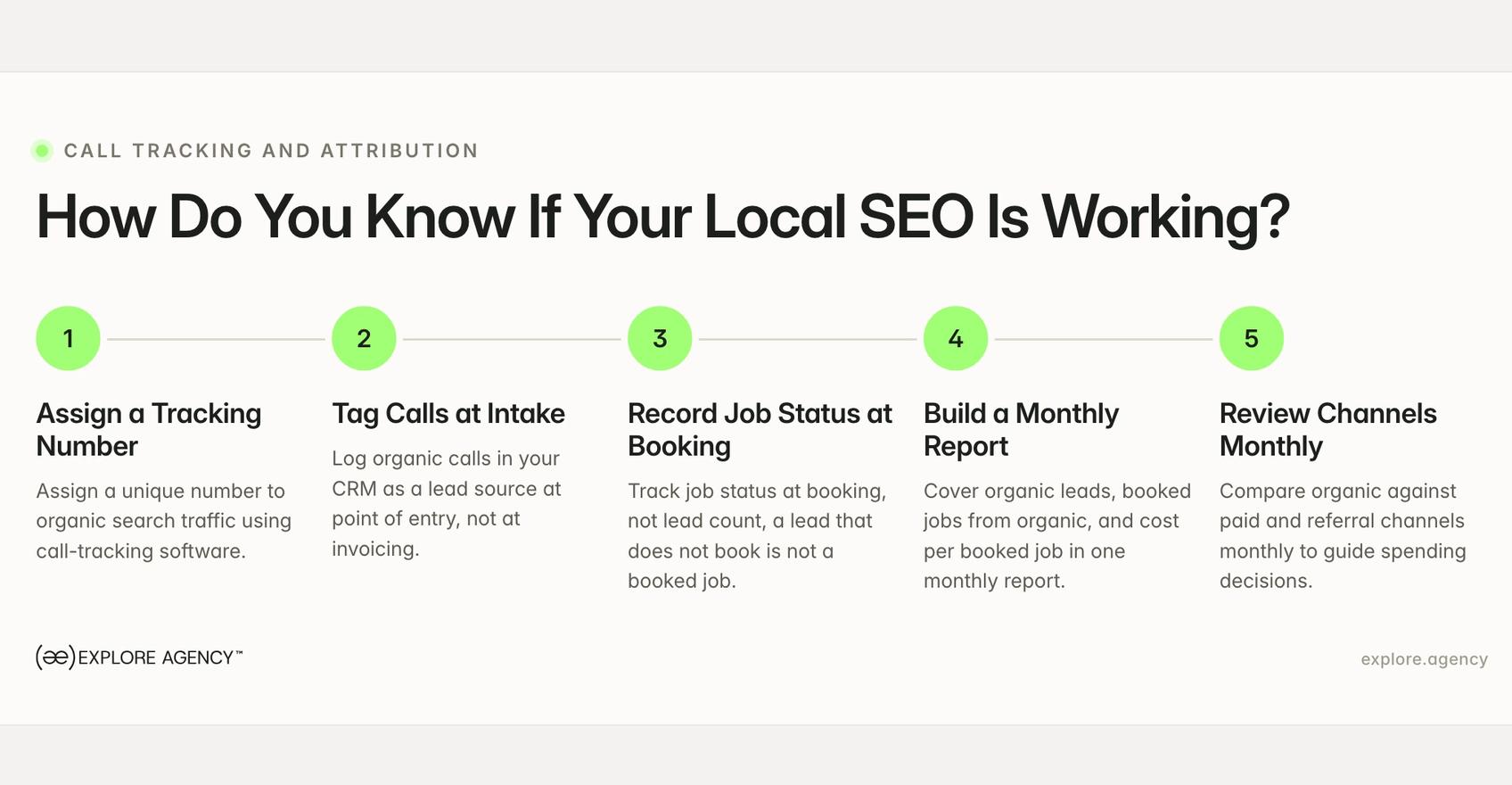
Tracking setup steps:
- Assign a unique tracking number to organic search traffic using call-tracking software.
- Tag organic calls in your CRM as a lead source at the point of entry, not at invoicing.
- Record job status at booking rather than lead count, since a lead that does not book is not a booked job.
- Build a monthly report covering organic leads, booked jobs from organic, and cost per booked job.
- Review organic against paid and referral channels monthly to inform spending decisions.
Frequently Asked Questions
What Does Local SEO Include for a Contractor?
Local SEO for contractors covers four areas: service pages targeting specific job types, service-area pages targeting cities in your territory, citation and NAP consistency across directories, and local content and links that build neighborhood-level authority. Google Business Profile optimization supports all four but operates through separate ranking mechanics that work alongside the website system.
How Long Does Local SEO Take to Work for a Contracting Business?
Citation corrections address existing inconsistencies and tend to have a faster impact than building new content authority, which takes longer to compound in competitive markets. The pace depends on market competitiveness, how much relevant content already exists on your site, and whether your technical foundation, including NAP accuracy and crawlability, is clean before work begins.
How Many Service-Area Pages Does a Contractor Actually Need?
Start with three to five pages targeting the cities that already generate revenue and have verifiable search demand. Thin pages built only for geographic coverage hurt rankings rather than help; each page needs unique content, real job proof from that area, and a reason to exist beyond the city name.
Can a Contractor Do Local SEO Without Hiring an Agency?
The foundational work, including auditing citations, building service pages, and writing one SAP per city, is learnable and doable in-house if the owner or a team member can commit consistent time each month. The attribution layer, connecting call tracking to a CRM and tying organic traffic to booked jobs, requires more setup and is where most DIY efforts stall before they produce a usable number.
How Do I Know If My Local SEO Is Actually Bringing in Booked Jobs?
Install call tracking that tags organic search calls separately from paid and direct traffic, then connect those call records to your CRM's job-status field. If your SEO report shows growing traffic but your schedule looks the same, the gap is usually in attribution rather than in the rankings themselves.
Ready to grow without the guesswork?
Explore Agency runs paid media, web and SEO as one integrated system — with revenue tracked to real booked jobs.