
Website
November 4, 2026

Website
11 min read


CSO & Co-Founder at Explore Agency
Bohdan (Bo) leads strategy at Explore Agency, where he and his team develop growth systems for businesses in the home services, healthcare, and legal sectors. Their work centres on helping organizations achieve more predictable and profitable growth.
Book a Discovery CallA flooring website books jobs when it has product pages homeowners can search by SKU, a quote form that works at 10 PM on a phone, and a booking path that moves each request into a CRM. This article covers which pages your flooring website design needs, what they cost to build, and how to connect them to closed jobs.
Here is what usually happens instead. A homeowner pins Mohawk SolidTech Pro on Pinterest, searches the product name on Google, and lands on Mohawk's site or Home Depot. Your showroom carries that exact product. No catalog pages means Google never offered your site as a result, and that is a catalog architecture decision, not a marketing budget problem.
A solid flooring website design has seven functional components working in sequence. Run through the list below as an audit before spending on ads or a visual redesign.
If your current site covers fewer than five of these, the gap is architecture, not visual style.
The home page has one job before the visitor scrolls: show that you are the right company for this homeowner, right now. That means your service area, a reviews badge with a star rating and review count, and one primary CTA visible without scrolling on a phone.
The typical home page fails this test. It opens with company history, a background video of an installation, or a tagline about craftsmanship. The homeowner searching "hardwood flooring contractor Charlotte" at 9 PM does not care about founding year. They want to know you serve their neighborhood, that other homeowners trusted you, and how to reach you now. Those three signals belong above the fold.
Product pages do two things simultaneously: they capture homeowners who already know what they want, and they give Google a page to match to SKU-level searches. Without catalog pages, every manufacturer-name search your potential customer runs resolves to the manufacturer's site, a big-box retailer, or a competitor who built those pages.
Each product page needs the SKU, finish options, manufacturer attribution, installation notes, and a quote link. The page does not need to look like a retail listing. It needs enough structured content for Google to understand what product is described, and a clear next step for the homeowner who lands on it.
Catalog architecture is the part of flooring website design most template builds skip entirely. Building those pages is a one-time decision that keeps generating organic traffic.
Only add a room visualizer after your catalog pages, quote form, and gallery are already converting. The tool increases time on site and reduces post-install complaints, because the homeowner has already seen the product in their actual room before the sale.
A visualizer does not fix a quote form with too many required fields. It does not fix a home page that takes six seconds to load on a phone. The investment earns out when the site converts without it. Build the core pages first.
If booking a showroom visit requires a phone call during business hours, you have already lost the homeowner deciding at 10 PM Sunday. They are comparing you against a competitor with an inline calendar on the page.
The gap is not difficult to close. A booking widget or a Calendly embed on the showroom page and the quote confirmation page closes this without a full rebuild. Sample requests follow the same logic. A "request samples" button that sends email to a general inbox is not a booking system. The homeowner wants confirmation something happened, and your team needs a CRM record.
The quote form is where most flooring sites lose the job. Most owners think the problem is ad spend. It usually is not.
Five fields is the right size: name, phone, email, project type (checkboxes: hardwood, LVP, tile, carpet, other), and a brief note. That is it. Three things follow submission: an automatic confirmation email with the next-step expectation, a CRM entry tagged with the traffic source, and a follow-up call within two hours. A lead called back hours after submitting converts at a meaningfully lower rate than one reached quickly, and that gap lives in the CRM handoff stage, not in ad targeting.
The GreenValley Flooring case study is a published flooring case study on the site.
A gallery converts when it matches the homeowner's project type. Before-and-after pairs showing kitchen hardwood, basement LVP, and bathroom tile do more for a homeowner planning those projects than a grid of styled product photography. The comparison reduces the perceived risk of hiring a contractor they have not worked with before.
Credible galleries have three elements: real job photos (not stock), room-type captions rather than just product names, and enough variety for homeowners to find a project similar to theirs. A gallery that only shows luxury custom installs creates the impression that the company does not take on the homeowner's project type.
A single home page cannot rank for every city you serve. A homeowner in Irvine and a homeowner in Newport Beach run different local searches. One home page captures one of them. Individual service area pages capture both.
Each page needs the city name in the title and heading, a paragraph specific to that location rather than a template with the city name swapped in, and the same quote form and trust signals as the home page. For companies with flooring website design orange county service coverage, individual city pages outperform a single regional landing page in local search.

The cost of a flooring website design project depends on what the site needs to do. A template-based build with a home page, gallery, and contact form is a different project from a conversion-focused build with catalog depth and CRM integration.
The factors that move the number most are catalog page count, mobile speed optimization, and whether the quote form connects to a CRM with automated follow-up. A flooring contractor website design that passes UTM data from an ad click through to a booked job requires a different architecture than a form that emails a general inbox.
Before requesting proposals, clarify what the site needs to accomplish. A brochure site and a conversion site with product pages and form-to-CRM integration are different scopes. That distinction determines whether the proposals you receive are answering the same question.
The right evaluation question is not "have you built flooring sites before" but "can you show me the quote form connected to a CRM on one of those sites." Portfolio aesthetics are easy to demonstrate. Conversion architecture is not.
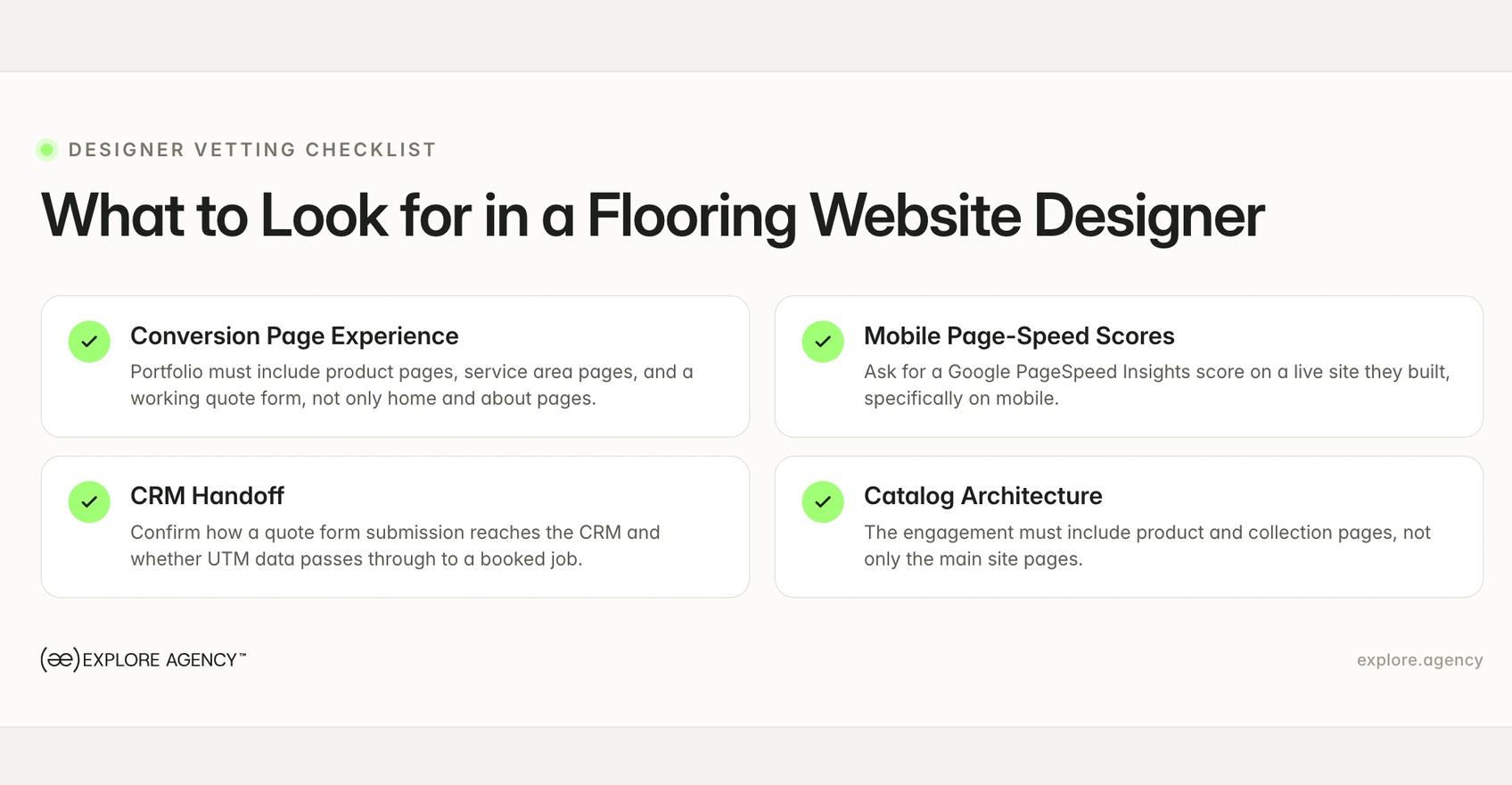
Four things to verify before signing:
A flooring website design engagement that covers only visual design and the home page leaves the highest-converting parts of the site unbuilt. The full scope includes product pages, service area pages, and form-to-CRM architecture as core deliverables, not add-ons.
Get Started
We help businesses turn strategy into measurable growth through better positioning, websites, paid media, SEO, and AI systems. Let’s look at what’s holding growth back and what to fix first.
Your site needs to load its main content in under 2.5 seconds on mobile. That is the threshold where Google's Core Web Vitals rate a page as "good" on the LCP (Largest Contentful Paint) metric. Below that level, both local search rankings and visitor abandonment become measurable problems.

Here is the owner-level translation. A homeowner on a mid-range phone, on an average mobile connection, hits your site at 11 PM. If the main content does not load quickly, a substantial share of those visitors leave before the quote form appears. They do not come back.
Fast load times affect two things you track: local search position and form completion rate. A slow site with uncompressed images and no caching configured is a rebuild decision. A slow site on a fast content delivery network with optimized images is an afternoon of work.
Test yours on a real phone, on a real carrier network. Not a desktop Chrome simulation.
Your website connects to booked jobs through a form-to-CRM chain that tags every submission with its traffic source. Without that chain, the form fires a pixel and the CRM has no record connecting a job to the campaign that produced it.
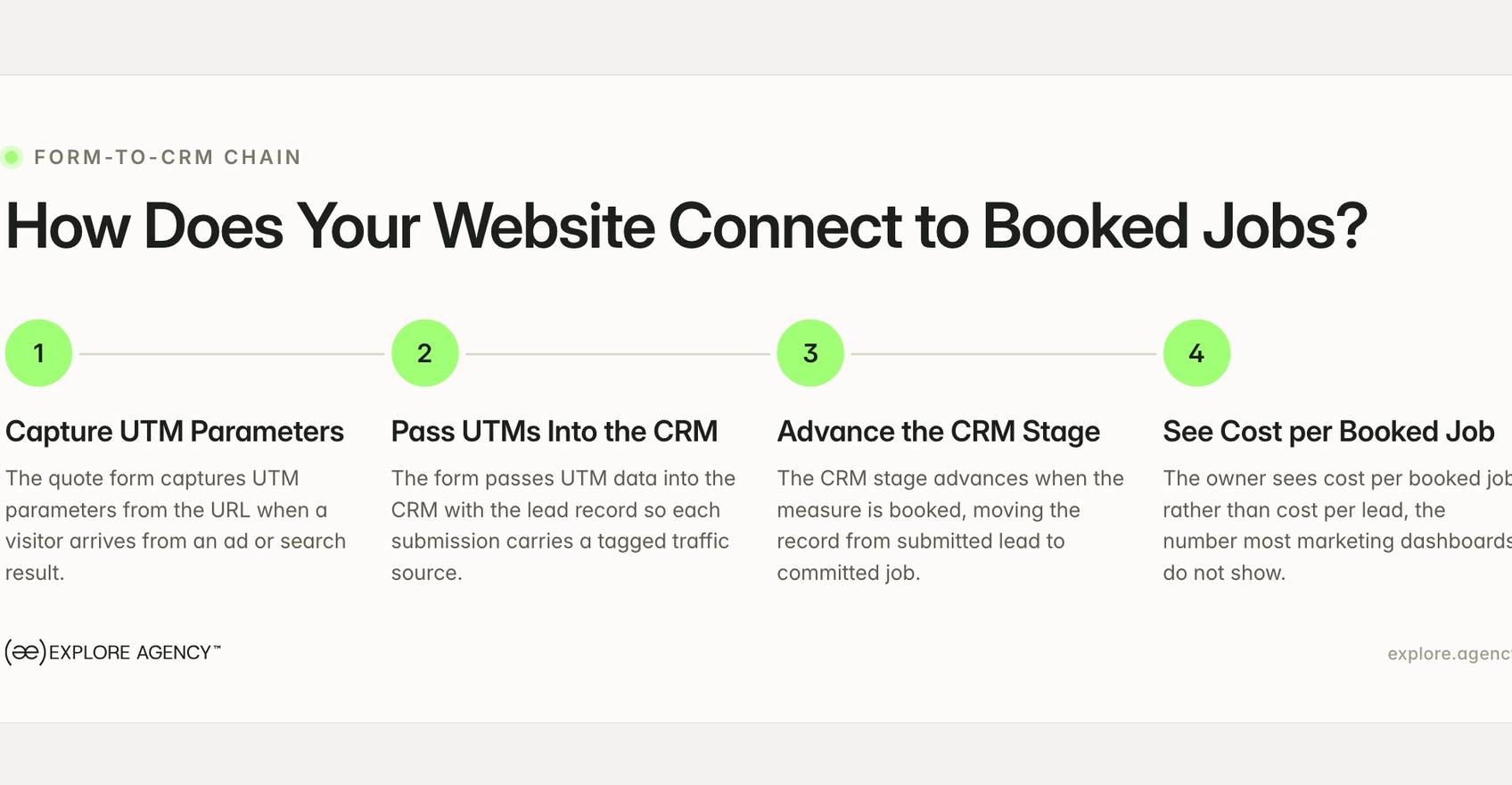
Here is a situation many flooring owners recognize. The Google Ads agency reports a strong lead count. The owner asks how many became booked jobs. No one knows. The form submission fires a conversion event in Google Ads, and the CRM has no UTM attached to the lead record. That is a website architecture failure, not an ads failure.
The traceable path works like this: the quote form captures UTM parameters from the URL and passes them into the CRM with the lead record. The CRM stage advances when the measure is booked. At that point, the owner sees cost per booked job rather than cost per lead. The difference between those two numbers is what most flooring marketing dashboards do not show.
This connection requires three things built together: a quote form that captures and passes UTMs, a CRM that accepts them in a structured field, and a stage definition that marks a measure as booked. None of this is advanced technology. It is architecture that standard flooring website design projects leave out because the brief was "build a website," not "connect marketing spend to jobs." Building it from the start is straightforward when paid, website, and SEO run as one integrated system.
The website is a conversion asset. It captures and qualifies the demand that is already searching for a flooring contractor in your market. Flooring marketing, including paid search, SEO, and social, drives traffic to that asset.
A redesign does not replace a campaign. A campaign cannot fix a broken quote form. Getting a new site and expecting more inquiries without traffic is one mistake. Running ads to a site that leaks every lead at the form stage is another. These are different problems with different solutions, and mixing them in a single proposal makes it harder to evaluate either.
For a full picture of how website and campaign work connect, see flooring marketing.
A flooring website needs a home page with local trust signals, product and collection pages tied to real manufacturer searches, a quote or measure request form, a project gallery organized by room type, and service area pages for each city you serve. A room visualizer and showroom booking widget add conversion value once the core pages are in place and working.
Cost depends on catalog page count, mobile speed optimization, and whether the quote form connects to a CRM with automated follow-up. A template-based brochure site and a conversion-focused build with product pages and CRM integration are different projects, and proposals should be compared on the same scope.
A visualizer earns its development cost when the rest of the site already converts: catalog pages built, quote form working, and gallery populated with real project photos. Adding a visualizer to a site that leaks leads at the form stage adds cost without addressing the reason visitors leave.
Conversion comes from three things working together: the right page for each buyer stage, fast load times on mobile, and a quote form that sends submissions directly into a CRM with automated follow-up. Missing any one of these breaks the chain between a site visit and a booked measure appointment.
Start with the quote form: reduce it to the five fields that matter, add an automatic confirmation email, and set a follow-up call window under two hours. If form traffic is low despite ad spend, the gap is usually missing service area pages or product pages that homeowners are finding on manufacturer and big-box sites instead of yours.
Explore Agency runs paid media, web and SEO as one integrated system — with revenue tracked to real booked jobs.
Articles
Website
November 4, 2026

Website
October 13, 2026

Website
September 25, 2026